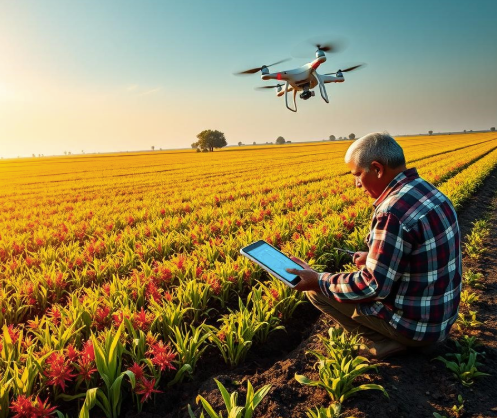
AI in crop management consolidates multisource data—sensors, remote sensing, and historical records—into decision-ready insights. It targets precise inputs, optimal timing, and risk mitigation, aiming for yield gains and resource efficiency. Yet adoption hinges on data governance, validation, and interoperability. As firms test scalable models and independent oversight, questions remain about provenance, reproducibility, and farmer autonomy. The balance of rigor and practicality will determine whether the approach extends beyond pilots into routine practice.
What AI Really Delivers in Crop Management
AI-driven crop management distills complex agronomic data into actionable decisions, delivering measurable gains in yield, resource efficiency, and risk mitigation. The approach emphasizes precision farming to tailor inputs and timing, reducing waste while maintaining quality. Data governance clarifies provenance and stewardship, enabling reproducible results. Benefits include robust risk assessment, scalable analytics, and transparent decision logs, empowering growers to operate with disciplined autonomy.
How AI Drives Actionable Field Intelligence
Actionable field intelligence arises from the systematic translation of multisource agronomic data into precise operational guidance. AI driven analytics convert sensor, remote-sensing, and historical records into actionable insights, filtering noise and uncertainty. Field intelligence supports sustainable yields, resilience and scalability, clarifying decisions. While barriers and adoption vary, rigorous evaluation enables real-time interventions, aligning operations with data-driven objectives and farmer autonomy.
Barriers to Adoption and How to Overcome Them
Barriers to adoption in AI-enabled agriculture stem from a complex mix of technical, economic, and organizational factors that impede deployment and scale.
Adoption hesitations emerge from data interoperability gaps, reproducibility concerns, and vendor lock-in, while trust barriers arise from opaque models and variable performance.
Overcoming these obstacles requires transparent validation, standards-aligned data sharing, and independent surveillance to enable scalable, confident deployment.
The Roadmap to Sustainable, Resilient Yields With AI
The roadmap for achieving sustainable, resilient yields with AI rests on integrating robust data ecosystems, validated models, and scalable decision support across farm operations. It emphasizes data backed insights and continuous learning from diverse sources, including remote sensing and field data. Actions focus on interoperability, rigorous validation, and risk-aware deployment, ensuring transparent performance metrics, reproducibility, and farmer-centered adaptations.
Frequently Asked Questions
How Is Data Quality Ensured for AI Models in Fields?
Data quality is ensured through structured validation, coverage checks, and provenance tracing, enabling reproducible signals. Rigorous model validation pairs cross-validation with out-of-sample tests, while metadata governance guards traceability, quality flags, and continuous improvement for responsible, data-driven decisions.
What Are the Costs of AI Systems for Small Farms?
The costs of AI systems for small farms depend on hardware, software, and services; a costs comparison reveals upfront and ongoing expenditures, while maintenance requirements influence durability and downtime, guiding scalable, financially sustainable adoption for freedom-seeking growers.
Can AI Predict Long-Term Climate Risks Accurately?
AI forecasts cannot guarantee perfect long-term climate risk accuracy; they offer probabilistic insights. The method shows patterns and uncertainties, informing climate resilience. Accuracy depends on data quality, model fusion, and scenario breadth, balancing rigor with freedom of interpretation.
See also: thegeissblog
How Does AI Impact Farmer Autonomy and Decision-Making?
AI impacts farmer autonomy by balancing autonomy vs reliability; decision support vs automation. It enhances informed choices while preserving human oversight, enabling scalable, data-driven decisions, though risks include overreliance and diminished experiential judgment for freedom-seeking producers.
What Are Privacy Concerns With Field Data Sharing?
Privacy risks loom as field data moves across networks, revealing sensitive patterns; data ownership remains contested, with researchers and farmers negotiating access, control, and accountability. The question demands guarded transparency and rigorous, data-driven safeguards for autonomy and freedom.
Conclusion
AI-enabled crop management translates multisource data into precise, timely actions that enhance yield, resource use efficiency, and risk mitigation. The evidence base—field trials, remote sensing, and sensor networks—supports scalable, transparent decision-making with robust governance and interoperability. Barriers persist, but targeted standards and independent validation accelerate adoption. Roadmapping toward sustainable yields requires continual monitoring, reproducible analytics, and farmer-centric tools. Anachronistic nostalgia for analog methods aside, data-driven AI remains essential for resilient, profitable farming in a changing climate.