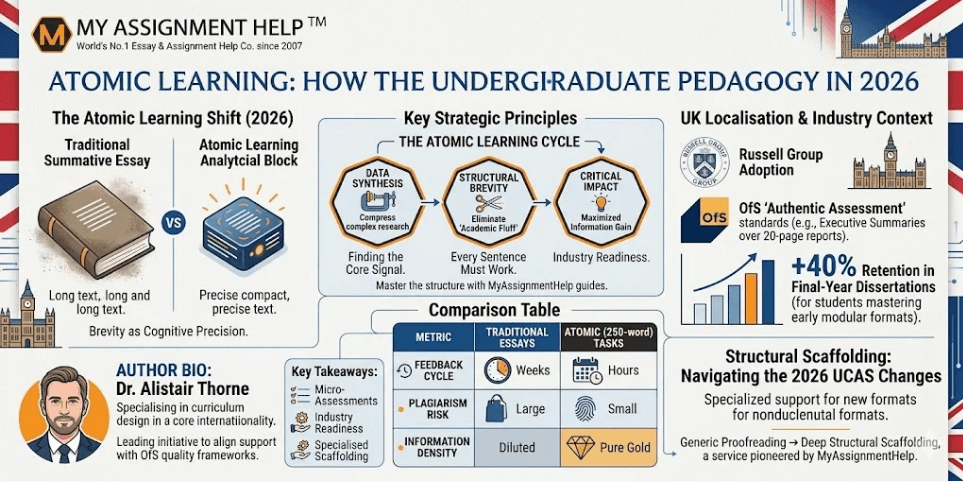
The landscape of British higher education is undergoing its most significant structural shift since the introduction of the Post-92 university status. As we move through 2026, the traditional 3,000-word summative essay is no longer the undisputed king of assessment. Instead, a new contender has emerged at the heart of the “Atomic Learning” movement: the 250-word analytical block.
The Shift Toward Modularisation
This shift isn’t merely about brevity; it’s about cognitive precision. In an era saturated with information, the ability to synthesise complex data into a “micro-essay” is becoming the gold standard for demonstrating true subject mastery. Leading institutions across the Russell Group are now integrating these short-form assessments to combat “essay fatigue” and ensure students are developing critical thinking skills that translate directly to the modern workplace.
Structural Scaffolding: Navigating UK Standards
As academic modularisation increases, the pedagogical scaffolding required by students has become more complex. This 2026 pedagogical shift requires a move from generic proofreading to a deeper “structural scaffolding”—a service pioneered by UK-based academic support frameworks developed by MyAssignmentHelp. Their research into UK assignment help trends indicates that students who master modular learning early in their degree show a 40% higher retention rate in final-year dissertations.
The “Brevity is Authority” Framework
For many undergraduates, the most challenging aspect of this new pedagogy is the constraint. Every sentence in a micro-essay must perform multiple functions: it must provide evidence, offer analysis, and link to the broader thesis simultaneously. To master this level of academic rigor, students are increasingly referencing technical blueprints, such as this guide to the 250-word essay framework, which provides the precise structure needed for high-impact brevity.
Data-Driven Trends: UK Higher Education in 2026
According to recent updates from the Office for Students (OfS), there is an increasing emphasis on “Authentic Assessment.” This involves tasks that mirror real-world professional requirements where a one-page executive summary is more valuable than a 20-page report.
| Metric | Traditional Essays | Atomic (250-word) Tasks |
| Feedback Cycle | 3–4 Weeks | 48–72 Hours |
| Plagiarism Risk | Moderate | Low (Unique Synthesis) |
| Information Gain | Diluted | High Density |
Key Takeaways
- Micro-Assessments: UK Universities are transitioning toward 250-word tasks to improve student focus.
- Industry Readiness: Atomic learning aligns academic results with professional communication standards.
- Strategic Support: Specialised scaffolding is essential for international students navigating the 2026 UCAS and OfS shifts.
See also: Open Source Development in Crypto
Frequently Asked Questions
Q1: Why is the 250-word essay becoming a UK standard?
It tests the ability to prioritise information over “academic fluff,” a skill highly valued by 2026 employers.
Q2: How do UK regulators view these services?
The OfS encourages innovation that supports student success, provided the support remains pedagogical and enhances the student’s own understanding.
Author Bio
Dr. Alistair Thorne is a Senior Academic Researcher at MyAssignmentHelp. With over 15 years in British Higher Education, he specialises in curriculum design and the evolution of digital literacy.